



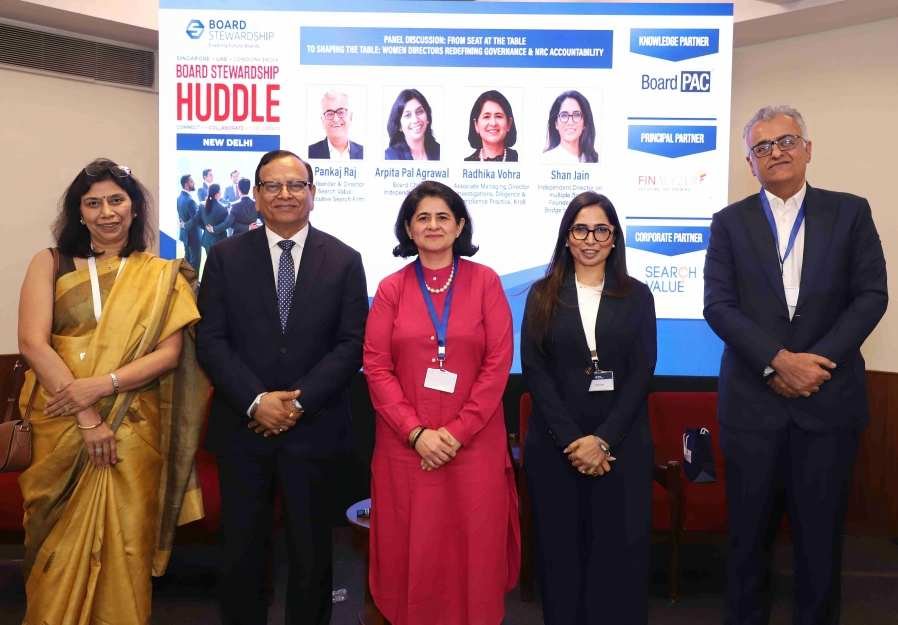
From Seat At The Table To Shaping The Table: Women Directors Redefining Boardroom Influence
The evolution of women’s roles in boardrooms is moving beyond representation to real influence, with Directors increasingly shaping governance, accountability, and leadership outcomes, noted speakers during a panel discussion at the Board Stewardship Huddle in Delhi.
The session, titled ‘From Seat at the Table to Shaping the Table: Women Directors Redefining Governance & NRC Accountability,’ was part of the Women’s Day Special edition of the Huddle held on March 17, 2026, at the India Habitat Centre. The event brought together board members, Independent Directors, governance professionals, and business leaders to deliberate on the changing dynamics of Board Stewardship.
Moderated by Pankaj Raj, Co-founder and Director, Search Value, the discussion focused on how Women Directors are increasingly influencing boardroom conversations. Raj observed, “The shift from representation to participation is now visible in the way women are contributing to discussions on risk, accountability, and leadership.”
The panel featured Arpita Pal Agrawal, Board Chair and Independent Director; Radhika Vohra, Associate Managing Director, Kroll; and Shan Jain, Independent Director and Founder & CEO, Bridge to Ocean 29.
Shan Jain contextualised the journey of Women on Boards, noting, “Regulatory mandates such as SEBI’s 2014 requirement ensured the presence of Women Directors, but influence did not automatically follow. The leadership pipeline remains limited, with structural challenges and mid-career drop-offs continuing to impact the number of women reaching senior roles.” She added, “Women often operate as ‘doers’ rather than ‘enablers,’ which can restrict their ability to scale impact. Board mandates ensure a seat, but influence is built through preparation, relationships, and the courage to ask uncomfortable questions. The next frontier is not representation—it’s impact.”
Radhika Vohra highlighted the role of self-perception, particularly imposter syndrome, as a barrier to leadership. “Self-doubt often prevents women from putting themselves forward, even in environments where opportunities exist. Organisations and leadership teams must address mid-career attrition and create ecosystems that enable women to sustain and grow in leadership positions. Increased representation at the Board level can create a ripple effect across organisations,” she said.
Arpita Pal Agrawal offered a more optimistic perspective, noting, “While the pipeline may be smaller, women who reach senior leadership roles are highly capable, having navigated more challenging career paths. This resilience translates into strong boardroom contribution, and the trajectory is steadily improving.”
The discussion underscored that while regulatory interventions have enabled representation, the focus must now shift toward building a stronger pipeline, addressing structural and mindset barriers, and enabling Women Directors to play a more active role in shaping boardroom outcomes.
“The next frontier is not representation—it’s impact,” Jain concluded, echoing a key theme of the Huddle. The panel formed part of the broader Board Stewardship Huddle, which centred on the theme of ‘Stewardship in Boardrooms’ and concluded with a felicitation ceremony followed by networking over cocktails and dinner.